
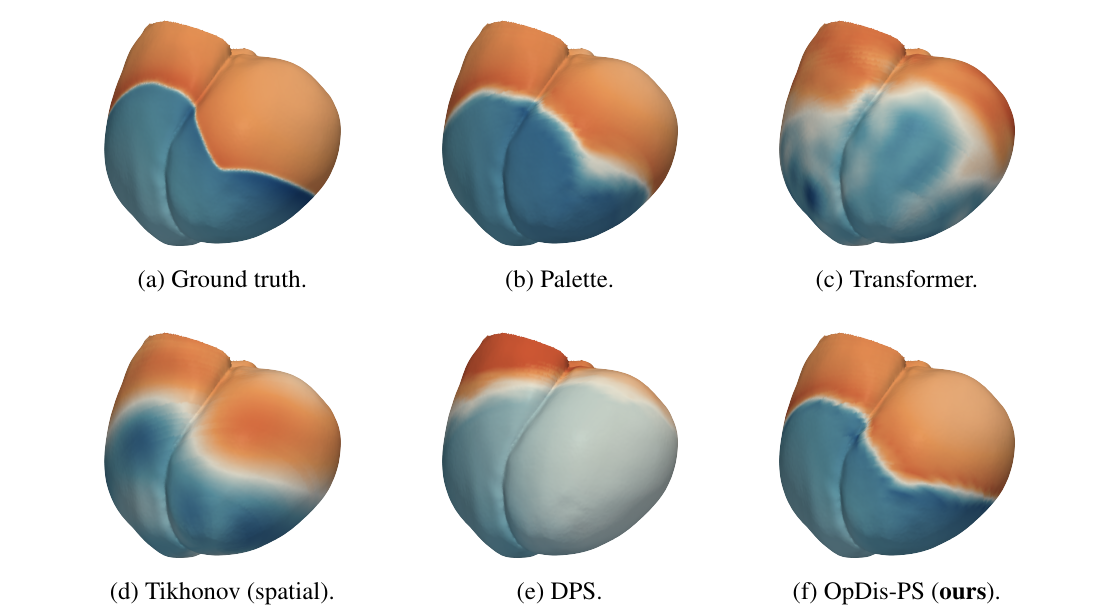
OpDis-PS. Reconstructing electrical activity on the heart’s surface from measurements on the body, while accounting for errors in the model that connects the two.
Abstract
Electrocardiographic imaging (ECGI) reconstructs heart-surface potentials from body-surface potentials, an ill-posed inverse problem. Diffusion posterior samplers combine a learned prior with an explicit forward operator that they assume to be accurate. In ECGI this operator is only an estimate, because the body changes with respiration and posture, and body composition such as subcutaneous fat is rarely known for an individual patient. The resulting operator discrepancy is structured and depends on the heart signal. We introduce OpDis-PS, a diffusion posterior sampler that models this discrepancy instead of treating it as signal-independent noise. OpDis-PS learns how the discrepancy depends on the signal, folds this into a corrected forward operator, and reconstructs with a fixed prior across all operator conditions. We study two realistic sources of discrepancy, changing lung conductivity and an added subcutaneous-fat layer. Across both, OpDis-PS reconstructs more accurately than classical regularization and learned predictors, with its largest gains on held-out cardiac pathologies.
Data & Code
ECGI Data for Reproduction and Future Research
The dataset combines simulated ventricular electrical activity with synthetic heart geometries and CT-derived torso anatomies. It includes 5,100 physiological training sequences, 100 validation sequences, 250 physiological test pairs, and 720 held-out pathological sequences, with evaluation under lung-conductivity and subcutaneous-fat variations. For research beyond the paper, all 6,170 heart-surface potential sequences are also available on their original, subject-specific heart surfaces, together with matching geometries, electrode locations, and nominal forward operators. The pathological data cover left and right bundle branch block and myocardial scar.
Download data on Zenodo ↗OpDis-PS
OpDis-PS models forward-operator discrepancy as a signal-dependent error, incorporating its predictable component into a corrected observation model and its remaining uncertainty into posterior sampling while keeping the diffusion prior fixed. The public release provides the pretrained models and supporting discrepancy artifacts used for the lung-conductivity and subcutaneous-fat variations. In a controlled ECGI evaluation, OpDis-PS demonstrates improved reconstruction under both conditions, with its largest gains on held-out cardiac pathologies.
Download code on GitHub ↗Paper & Poster
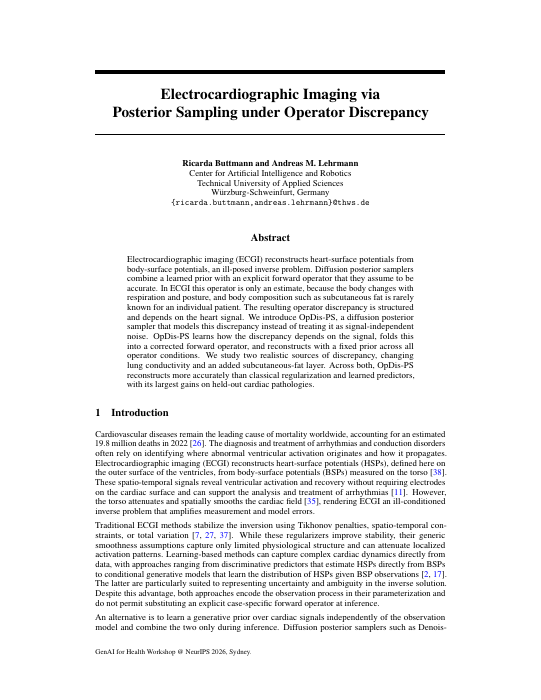
Paper
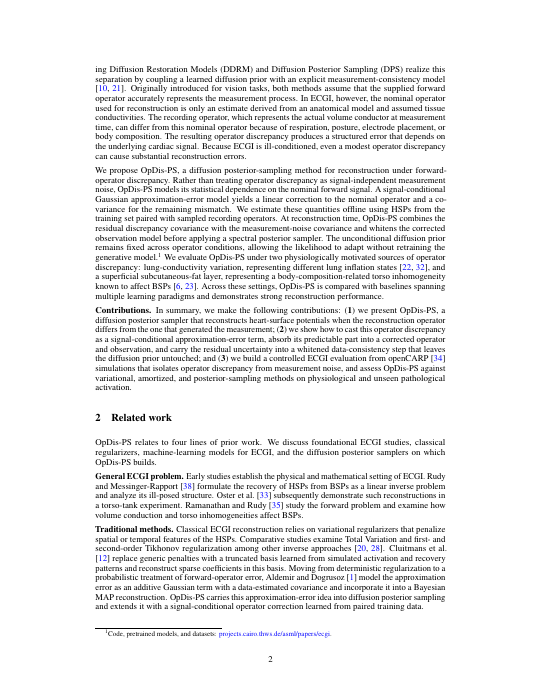
Poster
Citation
@article{buttmann26,
  title  = {Electrocardiographic Imaging via Posterior Sampling
            under Operator Discrepancy},
  author = {Buttmann, Ricarda and Lehrmann, Andreas M.},
  note   = {The Third NeurIPS Workshop on GenAI for Health},
  year = {2026}
}